
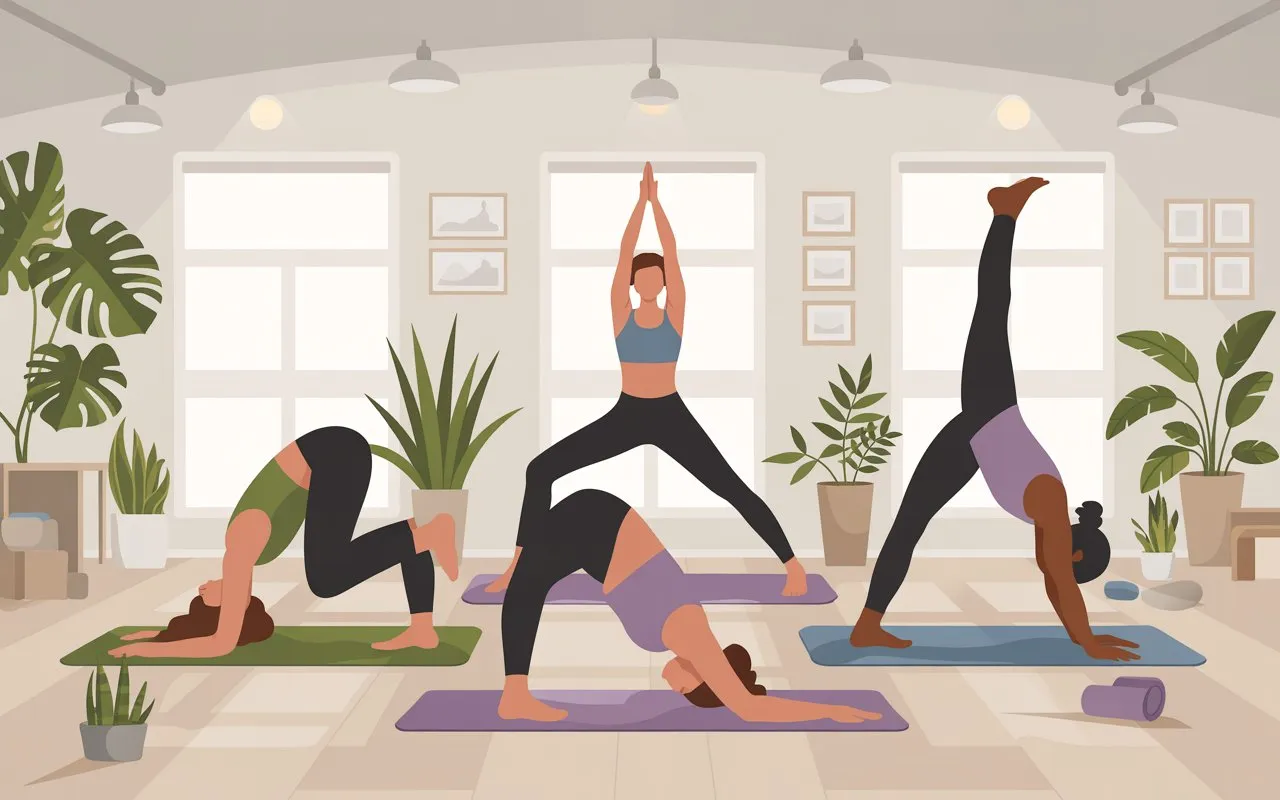
Yoga is more than just a form of exercise—it’s a framework of physical development, breath control, and mental training that builds strength, flexibility, and inner balance. Whether you’re brand new or already an experienced practitioner, yoga exercises can be tailored to your level and goals.
This guide is designed to introduce you to yoga simply and humanely—not overly specialized or overly spiritual, but rather valuable and applicable.
Why Yoga Exercises Are Important Today
Modern life is physically inactive and logically over-stimulated. Prolonged sitting, screen presentations, and exercise create the following:
- Back and neck pain
- Bad posture
- Anxiety and fatigue
- Poor adaptability and mobility
Yoga exercises illuminate these issues by combining controlled breathing and awareness with development.
Unlike gym exercises, which often isolate muscles, yoga trains the body as a unified system.
Divisions Of Yoga Exercises
To simplify matters, we divide yoga into three levels:
- Beginner yoga exercises – Establishment and Mobility
- Intermediate/Expert yoga exercises – Quality and Control
- Advanced/Extreme yoga exercises – Coordination, Continuity, and Efficiency
Let’s examine each level in detail.
1. Tenderfoot Yoga Exercises (Foundation Stage)
If you’re not used to it, your goal isn’t flexibility—it’s body awareness and consistency.
1. Mountain Pose (Tadasana)
This is the basis of all standing positions.
How to do:
- Stand straight with your feet together.
- Keep your shoulders relaxed.
- Activate your thighs slightly.
- Breathe slowly.
Facilities:
- Improves posture
- Creates awareness of body structure
- Strengthens legs and core
2. Descending Pooch (Adho Mukha Svanasana)
One of the essentials for beginners is yoga exercises.
How to do:
- Keep your hands and feet on the ground.
- Lift your waist to create a modified “V” shape.
- Press the floor with your heels.
Facilities:
- Hamstring and spine exercises
- Improves blood circulation to the brain
- Reduces back stiffness
3. Child’s Pose (Balasana)
A resting pose is used between exercises.
Facilities:
- Calms the anxious system
- Reduces back tension
- Reduces stress and fatigue
4. Cat-Cow Stretch
A simple stream between two locations.
How to do:
- On hands and knees
- Back arching (dairy animals) while breathing
- Rounded spine (cat) during exhalation
Facilities:
- Improves spinal flexibility
- Reduces back pain
- Improves breathing coordination
Advice for beginners:
Don’t rush. In yoga, control things rather than intensity.
2. Halfway / Master Yoga Exercises
At this stage, you already have the necessary flexibility and consistency. Now the focus shifts to quality, stability, and flow control.
1. Warrior Pose (Virabhadrasana I And II)
An effective standing posture.
Facilities:
- Increases leg strength
- Increases endurance
- Increases center and stability
Key idea: You should feel steady yet strong.
2. Board Pose
A waist-strengthening pose used in various yoga styles.
Facilities:
- Strengthens core muscles
- Improves the stability of the bear
- Increases endurance
3. Cobra Pose (Bhujangasana)
How to do:
- Lie down on your stomach.
- Lift your chest using your arms.
- Keep your waist on the floor.
Facilities:
- Strengthens the spine.
- Expands the chest and lungs
- Improves posture
4. Bridge Pose (Setu Bhadhasana)
Facilities:
- Strengthens the waist and hips.
- Improves blood circulation
- Reduces stress.
5. Sun Salutation (Surya Namaskar)
This is not a pose, but rather a full-fledged arrangement of yoga exercises.
It combines:
- Bend forward.
- Back bend
- Planck transition
- Controlled breathing
Facilities:
- Full body exercise
- Improves adaptability and strength
- Increases vitality
Best advice:
Focus on breathing coordination. Every movement should be coordinated with inhalation or exhalation.
3. Progressed / Extraordinary Yoga Exercises
Advanced yoga is not just about the outward form—it is fundamentally dependent on complete physical control and mental discipline.
1. Crow Pose (Bakasana)
Adjusting arm posture.
Facilities:
- Increases arm strength
- Improves coordination and attention
- Improves center control
Challenge: The fear of falling is the biggest obstacle, not strength.
2. The Supreme Being
Known as the ‘King of Yoga’.
Facilities:
- Increases blood circulation to the brain
- Improves center and mental clarity
- Strengthens the upper body.
Important: It can be said that exercises should be done under guidance.
3. Chakrasana
A deep bow.
Facilities:
- Stretches the chest and shoulders
- Strengthens the spine.
- Improves flexibility
4. Handstand (Adho Mukha Vrikshasana)
One of the most advanced yoga exercises.
Facilities:
- Increases the strength of the bear
- Improves balance
- Increases mental confidence
Advanced Tips:
Progress slowly. Advanced yoga is developed over months or years—not in a few days.
Breathing: The Control Behind Yoga Exercises
Most inexperienced people ignore this point, but breathing (pranayama) makes yoga powerful.
Basic breathing methods include:
- Deep belly breathing
- Breathing through one nostril
- Slow, controlled breathing
Why this is important:
- Reduces stress.
- Improves oxygen flow
- Increases concentration during postures
Without proper breathing, yoga becomes just a process of stretching the body.
Common Mistakes In Yoga Exercises
Many people fail at yoga because they:
1. Surge Progress
Yoga is not a competition.
2. Ignore Alignment
Incorrect posture can cause injury.
3. Abnormal Breath Holding
Breathing should be kept normal.
4. Sharpen Inconsistently
Consistency is better than intensity.
How To Create A Daily Yoga Routine
A simple structure:
Beginner (20-30 Minutes)
- Warm-up (5 minutes)
- Basic Asana (15 minutes)
- Rest (5-10 minutes)
Intermediate (30-60 Minutes)
- Surya Namaskar
- Power pose
- Balance exercises
Advanced (60+ Minutes)
- Flow order
- Reversal
- Deep stretching
- Meditation
Psychological Benefits Of Yoga Exercises
Yoga is not just physical.
It helps:
- Reduce anxiety
- Improve emotional control
- Increase mindfulness
- Build patience.
Over time, you don’t just change your body—your stress response also changes.
Latest Posts…
- Lizzo Weight Loss – What Is Authentic, What Is Misjudgment, And What Individuals Can Actually Learn
- Jelly Roll Weight Loss – What Has Really Changed, What People Don’t Understand, And The Truth Behind Its Transformation
- Lower Back Exercises – A Complete Guide To Beginner Progression (Build Quality And Avoid Pain)
- Glute Exercises – Extreme Direct For Beginners, Advanced Lifters, And Exceptional Development Training
- Hamstring Exercises – The Complete Guide For Beginners To Advanced Athletes
Last Words
Yoga exercises are a long-term practice, not a short-term fitness routine.
Beginners should focus on stability.
Experts should focus on control.
Advanced experts should focus on dominating the body and mind.
When practiced regularly, yoga is not just an exercise—it becomes a lifestyle that advances the way you move, think, and live.
Frequently Asked Questions (FAQs)
1. What are the best yoga exercises for beginners?
Beginners should start with simple poses that improve body awareness, posture, and flexibility. Some of the best beginner-friendly yoga exercises include Mountain Pose (Tadasana), Child’s Pose (Balasana), Cat-Cow Stretch, and Downward Dog (Adho Mukha Svanasana). These poses help build a strong foundation without putting too much pressure on the body.
2. How often should I practice yoga exercises?
For beginners, practicing yoga 3–4 times per week for 20–30 minutes is a great start. Intermediate and advanced practitioners can increase both the duration and intensity. Consistency matters more than long sessions, so regular practice delivers better physical and mental results over time.
3. Can yoga exercises help reduce stress and anxiety?
Yes, yoga exercises are highly effective for reducing stress and anxiety. Controlled breathing techniques, mindful movement, and relaxation poses help calm the nervous system, improve focus, and promote emotional balance. Regular yoga practice can also improve sleep quality and mental clarity.
4. Is advanced yoga suitable for everyone?
Advanced yoga exercises such as Handstands, Crow Pose, and Chakrasana require strength, flexibility, balance, and proper technique. Beginners should not rush into advanced poses. It is important to progress gradually and, when possible, practice under the guidance of an experienced yoga instructor to avoid injuries.

